

 CIRCE is a Spanish technology centre focused on solutions for sustainable development. In the REFRESH project, CIRCE is assessing new microwave-assisted processes for wind blade recycling.
CIRCE (Centro de Investigación de Recursos y Consumos Energéticos) is a Spanish technology centre located in Zaragoza. It was founded in 1993 with the aim of providing innovative solutions for sustainable development. CIRCE employs a highly qualified and multidisciplinary team of more than 280 professionals.
CIRCE’s mission is to improve the competitiveness of companies by generating and transferring technology through market-oriented R&D and training activities in the fields of sustainability and resource efficiency, energy networks and renewable energies. CIRCE’s activities deal with topics as diverse as smart grids, smart mobility, industry 4.0, energy efficiency and circular economy. It is an experienced partner in Horizon Europe R&D&I projects.
CIRCE’s role in REFRESH
The role of CIRCE encompasses the development of alternative energy-efficient thermal and thermo-chemical processes based on microwave-assisted heating (MWH) technology for the recycling of glass fibres and valorisation of resins from wind blade composite waste. Experimental MWH pyrolysis and solvolysis trials will be conducted at bench-scale MWH units using pre-shredded blade waste.
The recycled fibres, pyrolysis oils, chemical building blocks and energy-efficiency of the MWH processes will be characterised to assess the techno-economic viability of the developed solution. The recovered fibres will be sent to other partners in the consortium for integration in new products.
We spoke to Ignacio Julián, Project Manager, about CIRCE tasks in the REFRESH project.
What is CIRCE’s background in the wind energy sector?
CIRCE has broad expertise in the wind sector, having taken part in different European projects such as WENDY and AWESOME. Some of the works already carried out by CIRCE include different lines related to the wind energy sector such as wind performance assessment, wind equipment monitoring and the recycling of wind energy components.
Why did CIRCE decide to join the REFRESH project?
REFRESH project represents an opportunity to continue with the work already done in the wind energy sector through the development of new lines and technical proposals. REFRESH allows CIRCE to gain additional experience in the sector while performing innovative activities and testing different recycling routes. REFRESH activities will open different possibilities for EU innovation in the wind sector as well as enable transferability to the industrial sector.
How does the CIRCE microwave-assisted heating (MWH) technology work? What are the potential benefits of MWH blade recycling processes over the traditional processes?
Applied to fibre reinforced composites (FRP) recycling, traditional thermo-chemical recycling processes are quite energy consuming. The high temperatures required to run thermosets pyrolysis (300-550ºC), coupled with the typically low thermal conductivity of the resins involved, makes the process certainly inefficient. As such, thermal diffusion mechanisms under conventional heating (CH) require the heat source to be comparatively hotter than the required temperature to drive resins cracking and fibres isolation.
In contrast, microwave-assisted heating (MW) relies on the contactless, volumetric and selective heating mechanism provided by sample irradiation. Applied to composite materials, microwave irradiation has a key advantage against traditional heating sources: it can selectively heat certain target materials based on their dielectric properties and microwave-susceptibility. Specifically, applied to carbon fibre-based composites, microwave irradiation can selectively heat the fibres leading to more efficient and homogeneous heating of the surrounding resin matter. As such, the processing temperatures under microwave irradiation tend to be comparatively lower than these under CH and so is the overall power consumption.
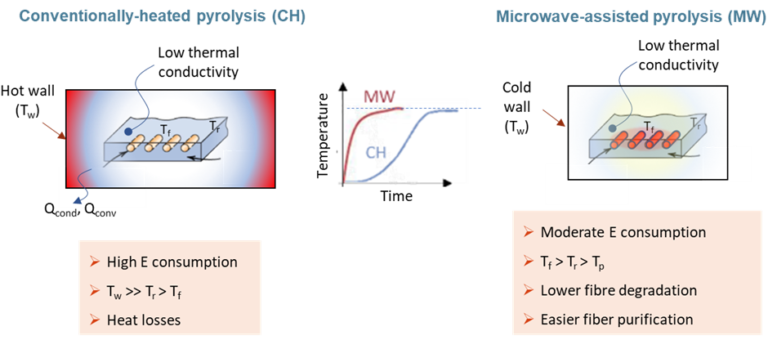 This has a two-fold effect. On one hand, it impacts the final quality of the fibres. limiting their thermal degradation. On the other hand, it enhances the controllability of the thermal cracking process, and thus the composition of the resin-derived products. Since the surrounding atmosphere is comparatively colder than the irradiated specimen, gas-phase thermal cracking reactions taking place at pyrolysis temperatures can be partially inhibited on demand to tune the composition of the released vapours.
Furthermore, heating processes driven by microwave irradiation are drastically faster than those conducted under conventional heating. Similarly, cooling processes also become faster thanks to the induced cooler environment within the reactor vessel in comparison to the heated sample.
This makes microwave-assisted heated systems ideal to minimise power consumption in batch thermal and/or thermochemical processes subjected to frequent start-up and shutdown events.
Nonetheless, this heating technology is fully electrified and can be directly run using power from renewable sources.
Within the framework of REFRESH, CIRCE is assessing the integration of microwave-assisted heating to pyrolysis and solvolysis routes for wind blade FRP waste chemical recycling. It includes MW-reactor design, experimental proof-of-concept, thorough product characterisation, as well as techno-economic and scalability assessment of both recycling solutions.
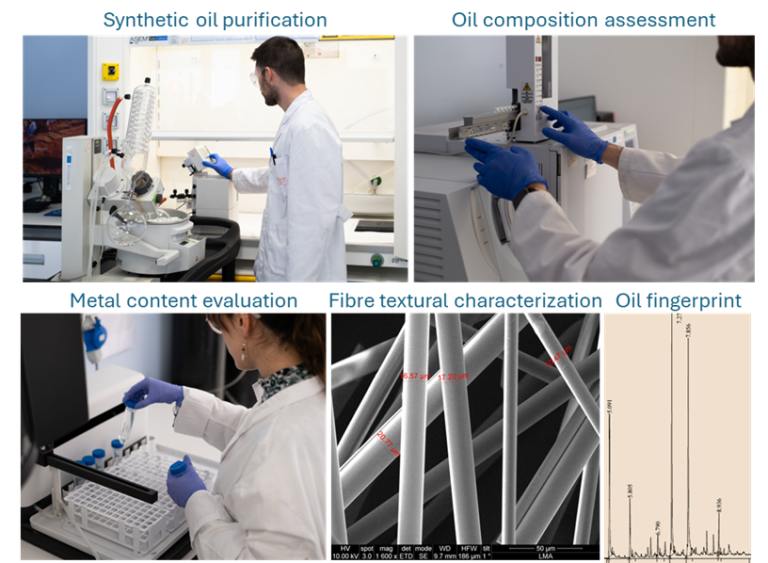
Typical oil characterisations assessed by CIRCE include gas chromatography coupled with mass spectroscopy (GC-MS), inductively coupled plasma coupled with atomic emission spectroscopy (ICP-OES), thermogravimetric analysis (TGA) and elemental analysis (EA). Analogously, the textural properties of fibres are characterised by scanning electron microscopy (SEM). In addition, CIRCE is equipped with a dielectric characterisation kit to assess the microwave susceptibility of the explored materials.
What are the challenges of scaling up the technologies from laboratory scale?
 Although microwave-heating and chemical waste recycling (pyrolysis and solvolysis) are consolidated technologies, their coupling into a MW-assisted reactor system for wind blade waste recycling represents a very recent technology at an early development stage. So far, experimental data and case studies are scarce and (to the best of authors’ knowledge) there is not any demonstration plant at industrial level based on this concept yet.
As such, despite the encouraging potential of the technology, the scalability of MW-assisted FRP recycling solutions is challenging and uncertain from the point of view of the lack of benchmarking references, the complex interaction of the microwave irradiation with such an uneven waste composition, and the size of the blade parts to be processed (in case long fibres are to be reclaimed).
What products could the recycled materials be used for?
Essentially, both chemical recycling routes lead to the production of reclaimed fibres (either glass- or carbon-based) as well as a resin-derived oil and incondensable gases. Additionally, solid carbonaceous deposits (char) are typically produced in case of pyrolysis.
Depending on the size of the reclaimed fibres and their remaining mechanical properties, these can be employed as fillers in construction materials or repurposed for further fibre-reinforced composite applications with less demanding mechanical requirements.
Oils can either be used as building blocks to produce new resins and plastics (circular economy) or as second-generation fuels. Char can be used as adsorbent e.g. for remediation or purification purposes.
Lastly, the gaseous hydrocarbons, which typically contain relevant amounts of methane and hydrogen, can either be used as fuel or precursor of syngas for further chemicals production.
What are you hoping to have achieved by the end of the project?
The aim of CIRCE within REFRESH is to experimentally validate a MW-assisted FRP recycling technology and gain insight into its potential and limitations. Based on the benchmarking MW-pyrolysis and MW-solvolysis experimental findings, a techno-economic assessment will be followed to evaluate the viability of each technology as well as to elucidate the potentially achievable energy efficiency and process scalability.
By the end of the project, CIRCE aims to get a clear picture on further development steps to be conducted towards the commercialisation of a first-of-a-kind MW-based wind blade waste energy-efficient recycling process technology for enhanced quality of reclaimed fibres and oils.
Read about our other partners:
REFRESH participates in WindEnergy Hamburg as member of Wind Innovation Cluster Hub
REFRESH at WindEnergy Hamburg 2026